New article in ISA flagship journal International Studies Quarterly
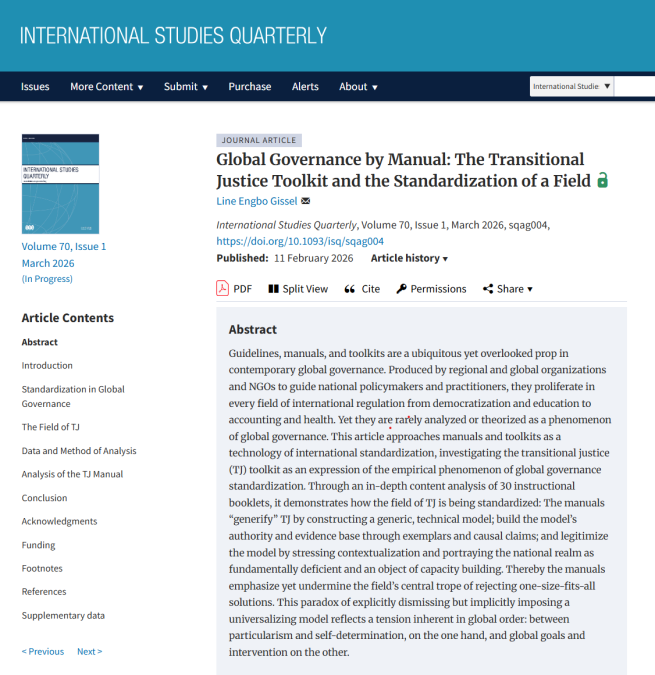
The project conceptualises standardisation as comprising two interdependent sub-processes, 'generification' and 'localisation'. This conceptualisation borrows from scholarship on standardisation (Demortain 2008). So how is the generic model - standard - developed? A new article published in International Studies Quarterly investigates the world-making and world-ordering properties of manuals, toolkits and guidelines. The article analyses how transitional justice (TJ) manuals build a generic model, imbue it with authority, and legitimise it. It theorises 'global governance by manual', arguing that informal standardisation by public bodies of global governance relies on manuals with normative, constitutive power. In the process of this investigation of 30 manuals, toolkits and guidelines, the article generates some surprising findings: the field's reliance on authoritative claims without truth value; its use of exemplars and examples; the fact that there is indeed 'one size fits all' and the construction of an overwhelmingly deficit national domain.
The article's abstract
Guidelines, manuals, and toolkits are a ubiquitous yet overlooked prop in contemporary global governance. Produced by regional and global organizations and NGOs to guide national policymakers and practitioners, they proliferate in every field of international regulation from democratization and education to accounting and health. Yet they are rarely analyzed or theorized as a phenomenon of global governance. This article approaches manuals and toolkits as a technology of international standardization, investigating the transitional justice (TJ) toolkit as an expression of the empirical phenomenon of global governance standardization. Through an in-depth content analysis of 30 instructional booklets, it demonstrates how the field of TJ is being standardized: The manuals “generify” TJ by constructing a generic, technical model; build the model’s authority and evidence base through exemplars and causal claims; and legitimize the model by stressing contextualization and portraying the national realm as fundamentally deficient and an object of capacity building. Thereby the manuals emphasize yet undermine the field’s central trope of rejecting one-size-fits-all solutions. This paradox of explicitly dismissing but implicitly imposing a universalizing model reflects a tension inherent in global order: between particularism and self-determination, on the one hand, and global goals and intervention on the other.