Fieldwork for Master’s thesis in Nuuk: Turning the gaze to Danish coloniality
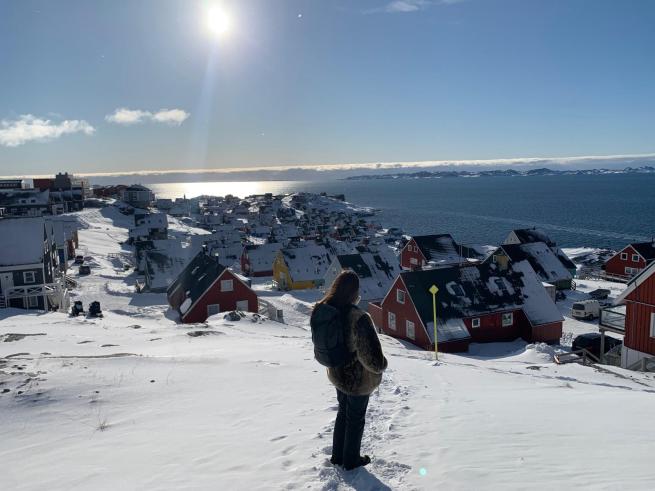
These lines come from Emma’s journal on her way to Nuuk. Excitement and nerves were building as we approached the task ahead of us.
Young Danes Working and Living in Nuuk
We are two students writing our master’s thesis in Global and Development Studies at RUC. We enter this project with different personal histories and cultural backgrounds, and we see our positionalities as central to the way we approach the field.
Emma is from northern Germany and part of the Danish minority, having gone to Danish school all of her education. Naja grew up in Norway, but also has a Greenlandic-Danish family background, and lived in Nuuk the previous semester doing an internship. These differences shape how we navigate the field and how we reflect on the power dynamics involved in doing research in Nuuk.
As Greenland has experienced a lot of international attention and pressure, public conversations and debates about the history and present of the Greenlandic-Danish colonial relationship have resurfaced. Through debates in traditional and social media, we have seen that the narrative of Denmark as a “benevolent colonizer” is still very much alive, especially in the older generation in Denmark. But what does this narrative look like among the younger generation of Danes who actually live and work in Nuuk?
In our thesis, we investigate how young Danes in Nuuk understand the Greenlandic-Danish relationship, and how they position themselves and navigate everyday life in Nuuk as Danes. We want to understand how they make sense of their own presence, how they reflect on their role in a society shaped by colonial history and present, and what they hope the future will look like.
Why This Matters
Our inspiration comes from Greenlandic researchers and activists who have expressed frustration with Danish and foreign researchers studying Greenland and Greenlanders through Western frameworks and institutions. Additionally, when combined with this problematic history of research in Greenland and on Greenlanders, the intensified pressure from foreign actors, especially in recent years, has contributed to a growing sense of research fatigue. As part of broader efforts toward decolonization, they encourage researchers from Denmark and other Western contexts to turn their gaze toward the structures on the colonial side and critically engage with the dynamics that reproduce coloniality.
Our thesis examines a small part of this: how young Danes living and working in Nuuk may reproduce, negotiate, or challenge coloniality - and how they understand their own role in this.
Our Fieldwork: Experiences and Reflections
Over the past weeks, we have collected data through interviews, observations, and autoethnographic reflections. We have listened to different perspectives, thoughts, and opinions, while at the same time navigating our own. As interviews unfolded, and as we discussed the project with people we met daily, we found ourselves reflecting on the interviews themselves and the emotions they stirred in us.
The fear we carried with us before the journey, that we would find ourselves in uncomfortable situations and have to ask difficult, even provoking questions, quickly proved to be true. Meeting others, and especially confronting our own prejudices, became an essential part of the process. Learning to sit with that discomfort, and allowing ourselves to learn from it, turned into a personal journey that went far beyond anything we could have anticipated.
We do not pretend that we as researchers can be neutral or value-free. On the contrary we are ourselves embedded in the narrative we are trying to understand and question. Inevitably, we see the world through the lens of who we are - our backgrounds, beliefs, and positionalities - and through the theoretical frameworks we choose. We are not attempting to hide this, but rather highlight it.
To break colonial patterns, we believe these reflections are essential. Our hope is to make them a central part of our written thesis in the end.
How it all turns out, we will see in the coming months.