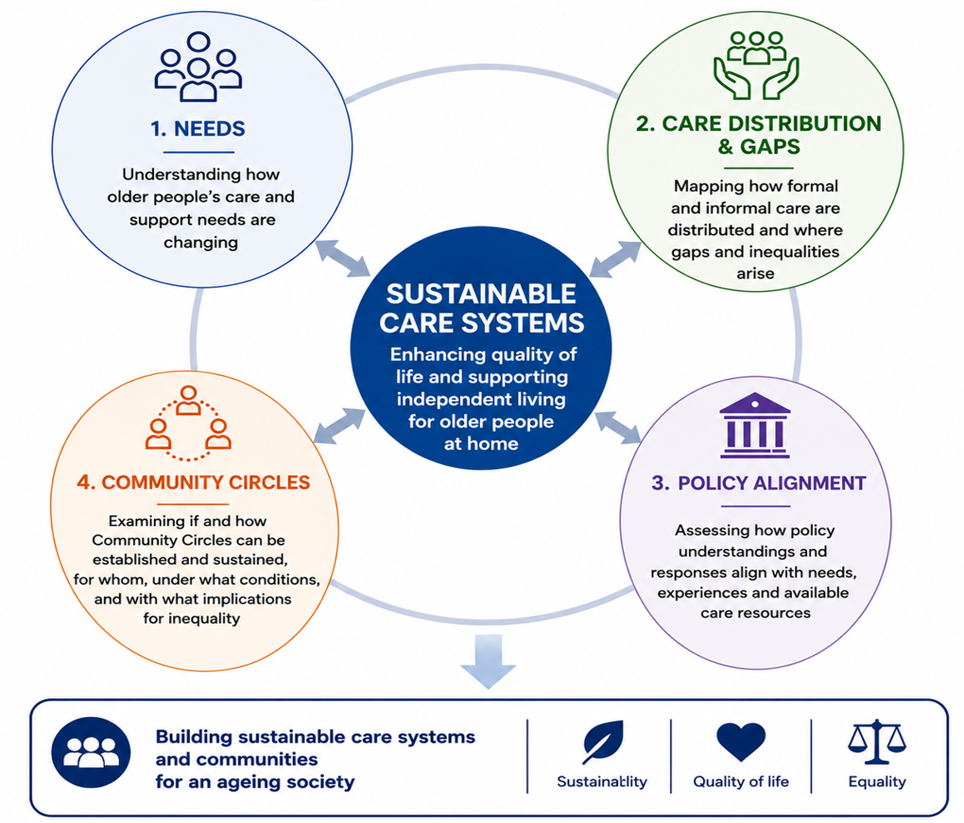
SustainCare is organised into six interconnected work packages. Four work packages address the project's main research questions, while two provide cross-cutting activities relating to participatory engagement, project coordination and dissemination.
WP1 – Care Needs: Now and in the Future
WP1 investigates present and future care needs among older people living in the community in Denmark, Finland, Sweden and Lithuania.
The work package examines how demographic change, health and functional limitations influence the need for assistance and care, and how these needs may develop as populations age.
Through comparative analyses of existing survey data, WP1 contributes to a better understanding of the scale and distribution of care needs and the challenges facing long-term care systems.
WP2 – Care Resources, Unmet Needs and Care Poverty
WP2 investigates how care is provided and distributed between formal services, family members and other informal sources of support.
A central concern is whether existing care arrangements adequately meet older people's needs, and which groups are particularly vulnerable to insufficient support or care poverty.
The work package applies survey data to examine inequalities in access to care and differences between countries and population groups, contributing to our understanding of how care responsibilities are distributed across welfare systems.
WP3 – Policy Reforms and Problem Identification
WP3 examines how long-term care challenges are understood and addressed in public policy across the four countries.
The work package analyses policy reforms and the assumptions underlying proposed solutions, including how responsibilities are allocated between public services, individuals, families and communities.
A particular focus is whether policy problem definitions and proposed responses correspond to older people's actual needs and to the perspectives of users and stakeholders.
WP4 – Community Circles: Development, Implementation and Evaluation
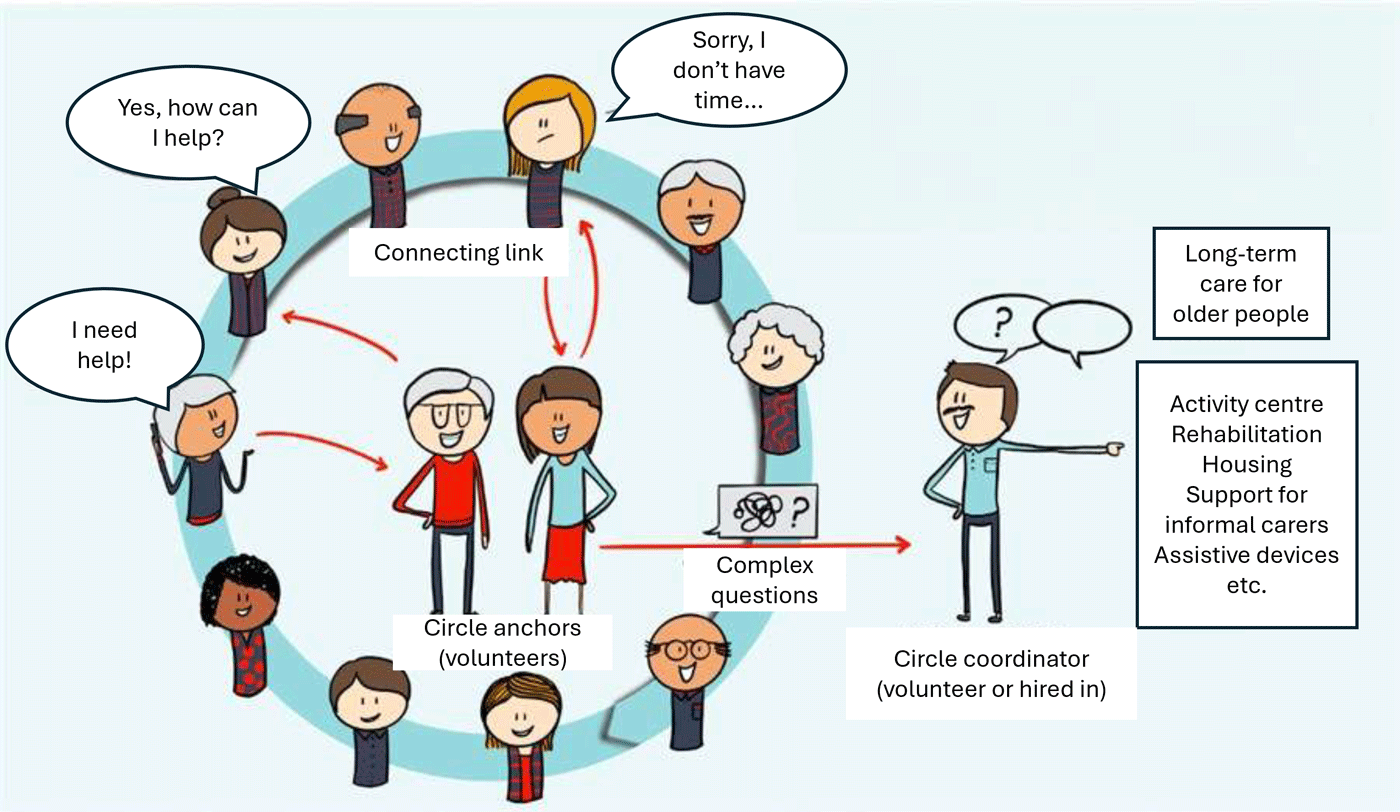
WP4 investigates the development, implementation and early outcomes of Community Circles[TR5.1] in local settings across the four participating countries.
Community Circles are neighbourhood-based networks in which people voluntarily support one another through everyday assistance, companionship and mutual care.
Working with local partners, the project explores how such initiatives can be adapted to different contexts, how people become involved, how mutual support develops, and what opportunities and challenges arise in practice.
The research combines qualitative and quantitative approaches to investigate the development, functioning, feasibility and potential contribution of Community Circles.
WP5 – Participatory Design and Stakeholder Engagement
WP5 supports the involvement of stakeholders and practice partners throughout the project.
Through engagement with national stakeholders and local actors, the work package brings perspectives from policy, practice and civil society into the research process.
These activities help inform the project's analyses, support the development of locally relevant approaches and facilitate dialogue about the implications of research findings.
WP6 – Project Management, Integration and Dissemination
WP6 coordinates the international research collaboration and supports integration across work packages and countries.
It facilitates scientific exchange, project management, dissemination and dialogue with stakeholders.
A central objective is to ensure that the findings from the different research activities contribute to a coherent understanding of sustainable long-term care systems and are communicated to relevant academic, policy and practice audiences.