New Study Challenges Simple Links Between Resource Scarcity and Violence
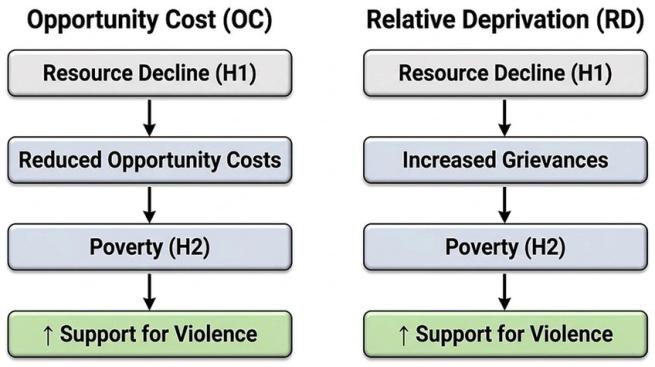
Climate change and environmental degradation are often presented as potential drivers of conflict. The usual argument is that declining access to land, water and other natural resources increases poverty and competition, creating grievances that may eventually lead to violence.
A new study published in Frontiers in Political Science puts this assumption to the test. Researchers Ole Magnus Theisen, Xi Jiao, Kasper Hoffmann and Martin Reinhardt Nielsen examined whether households experiencing resource decline or poverty were more likely to express support for violence. The study is based on interviews with 994 households in 25 villages surrounding the Greater Serengeti–Mara ecosystem in Tanzania and Kenya.
The region provided a particularly relevant setting for the study. Many households depend directly on farming, livestock and natural resources, while conflicts over land, grazing areas, water and conservation have occurred in parts of the region.
The researchers compared household attitudes towards violence with reported changes in crop productivity and access to pasture, water and firewood over the previous five years. They also used detailed information about household income, livestock, farmland and other assets.
The results do not support a simple connection between scarcity, poverty and support for violence. Households reporting declining resources were not consistently more supportive of violence than other households. Absolute household income was also unrelated to support for violence. Some results even suggested that households with more livestock or land were slightly more willing to support taking up arms to defend their rights, although these relationships were weak and should not be overinterpreted.
Experiencing or witnessing an actual resource dispute was more closely associated with support for violence than resource decline itself. This distinction is important: scarcity does not automatically become conflict. Political conditions, local institutions, social relations, and the ways disputes are managed may determine whether environmental pressures are resolved peacefully or escalate into violence.
The findings are directly relevant to VUCCA’s work on climate vulnerability and adaptation in conflict-affected regions. They caution against assuming that poorer or more resource-dependent households are inherently more prone to violence. Understanding the climate–conflict relationship instead requires attention to institutions, inequalities, historical experiences and the local processes through which environmental pressures become social and political grievances.
Note: The study concerns attitudes towards violence rather than participation in violent acts, and the data were collected in 2016–2017. Its central contribution is therefore not an assessment of current levels of conflict, but a test of the mechanisms commonly assumed to link environmental change to violence.
Find the full study here: https://doi.org/10.3389/fpos.2026.1742315