Justice visions by Syrian TJ entrepreneurs, activists, experts
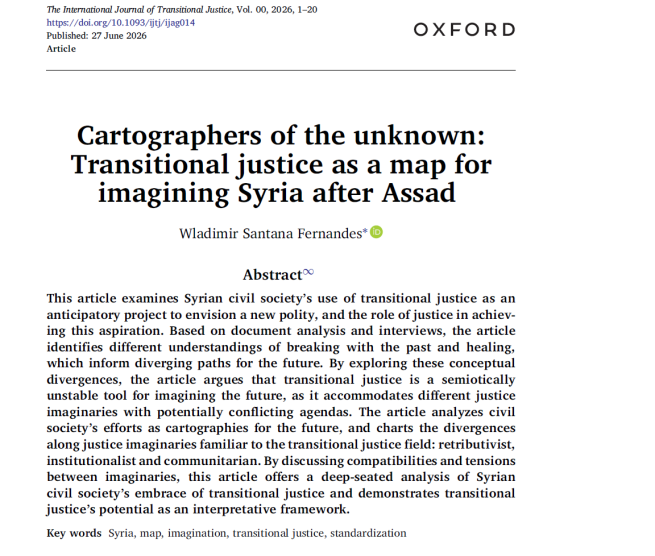
How does transitional justice lend itself to the imagination of a new polity? During the Syrian civil war, project member Wladimir Fernandes investigated how transitional justice discourse and 'the TJ model' informed the thinking and advocacy by Syrian civil society organisations. He interviewed many diaspora Syrians in Germany, The Netherlands, Austria and Denmark about their justice work, observed TJ meetings and workshops, and analysed their justice maps, briefings and brochures.
The result is an argument about their 'justice imaginaries' of which he identifies three: retributivist, institutionalist and communitarian. Each involves a vision for a future post-Assad Syria in which some form of justice plays a role. Justice or TJ is clearly not just one thing, nor do survivors of the Syrian civil war want the same kind of justice. The article argues that
transitional justice is a semiotically unstable tool for imagining the future. As the article has shown, justice actors mobilized transitional justice’s concepts and metaphors, such as ‘breaking with the past’ and ‘healing,’ to chart different paths to a future Syria, from which they conceived different formal and informal programs of action, and spaces and agents of justice. Far from a universal transitional justice imaginary, these divergences show articulations of transitional justice categories that were not homogenous, and were potentially irreconcilable. This semiotic instability challenges developments in mainstream transitional justice practice, particularly its standardization, which assumes that transitional justice can be turned into a transferable model based on universal meanings and concepts. The fact that divergences map into categories familiar to transitional justice – retributivist, institutionalist and communitarian – demonstrates instead transitional justice’s potential as an interpretative framework.